"What is he that builds stronger than either the mason, the shipwright, or the carpenter?"
Header image

Since when do ghosts have ear?

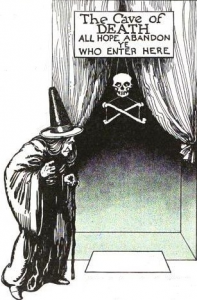
Last year, I had high hopes for the 2011 installment of my “Vintage Halloween Insanity” series. Not only had I found a walk-through description of a 1915 haunted attraction, but it was quite possibly the most ludicrously dangerous of the old Halloween articles I had ever found after it seeming like I had run out of material. “The Cave of Death” certainly lived up to its name. Sadly, that was not the case this year. Don’t get me wrong, I did manage to scrape together enough material to form this article, but it doesn’t have quite the same impact as the previous year’s installments. That said, it is still interesting reading.

While browsing through my usual sources for “Vintage Halloween Insanity” fodder, Popular Science and Popular Mechanics, I noticed that most of the Halloween-related stuff was rather normal when compared to past years’ entries in the series. Although not technically a Halloween article, this moving ouija board that promotes tuberculosis awareness is plenty weird. Although this 1937 article has a few good Halloween ideas, most of it is filled with stuff that seems more appropriate for April Fools’ Day. Only the collapsing chair and shaking table seem potentially risky, which is quite the comedown from previous years’ entries in this series.

With that resource tapped, I tried looking through the free Google eBooks next. This issue of The Practical Druggist shows that even back in the 1920′s, pharmacies stocked Halloween goodies and built spooky displays in October. The unusual newspaper ad done in a mock play format is amusing, but not up to the usual standard of insanity I’m used to. The National Drug Clerk amps things up with a display that constantly references “the Huns” (despite the article’s comments on using Halloween fun to take kids’ minds off the war) and its suggestion of covering bare light bulbs with blue tissue paper to create interesting lighting effects. Yeah, I’d imagine a fire would definitely be an interesting lighting effect.

The Boy Craftsman mostly focuses on Halloween pranking devices, although the “goblin man” does ramp up the insanity factor. A scarecrow with a tissue paper and cardboard head lit by a candle is dangerous enough as it is, but a scarecrow that one is expected to strap on and walk around in while peeping out of a small hole is just asking for trouble. But the trail went cold after making that discovery.

Atomic Mystery Monster (who showed me the Modern Mechanix article that was featured in the first installment of “Vintage Halloween Insanity) came to the rescue by showing me some other weird articles from that magazine, along with something from a 1915 issue of Boys’ Life that he saw at a forum he frequents. Although “The Great Scout Snout Hunt” is a tale of the intended victim of the infamous snipe hunt prank turning the tables on the would-be pranksters, the spooky pranks he uses form what could be considered as a crude haunted trail. In fact, one of the pranks in the “trail” is somewhat similar to the above-mentioned “goblin man.”

Oddly enough, 1915 can be considered a major year for old school haunted attractions. In addition to the above “prototype haunted trail,” 1915 also marks the year the “Cave of Death” attraction I mentioned at the beginning of this article ran and the Hollycombe Steam Collection actually has a mechanized haunted house which was manufactured that year. Going back even further reveals that homemade haunted houses existed in the 1800′s! Although the exact details about what were featured in them are scant, I’d say decorating using rags and lit candles are a definitely dangerous combination that fits in with the theme of this series. Edgar Allan Poe’s 1842 classic “The Masque of the Red Death” also describes what can be considered an early home haunt:

“The seventh apartment was closely shrouded in black velvet tapestries that hung all over the ceiling and down the walls, falling in heavy folds upon a carpet of the same material and hue. But in this chamber only, the color of the windows failed to correspond with the decorations. The panes here were scarlet — a deep blood color. Now in no one of the seven apartments was there any lamp or candelabrum, amid the profusion of golden ornaments that lay scattered to and fro or depended from the roof. There was no light of any kind emanating from lamp or candle within the suite of chambers. But in the corridors that followed the suite, there stood, opposite to each window, a heavy tripod, bearing a brazier of fire, that projected its rays through the tinted glass and so glaringly illumined the room. And thus were produced a multitude of gaudy and fantastic appearances. But in the western or black chamber the effect of the fire-light that streamed upon the dark hangings through the blood-tinted panes, was ghastly in the extreme, and produced so wild a look upon the countenances of those who entered, that there were few of the company bold enough to set foot within its precincts at all.”

My final bits of haunted house related insanity from days gone by come from some books I read as a child. Although there are no online previews available for Elizabeth Wilkinson’s Making Cents or Shari Lewis’ Spooky Stuff, both are available at extremely low prices. Making Cents suggests creating “Ghoul Drool” by hanging wet yarn from strings of Christmas lights(!) and has a bizarre preoccupation with using cat food in displays while Spooky Stuff suggests having hidden assistants grab at guests’ ankles while lying in doorways along a hall. Although Lewis’ idea might not sound so bad at first glance, going over haunt expert Bertram Bertram’s guest articles on rules and safety at haunted attractions will make it clear why I have included it here. Remember: There’s a reason why most haunted attractions don’t let their performers touch guests…

Getting back to WikiSource, here’s an old (but newer than most of the featured links in this series) promotional Halloween image that seems innocent at first glance. That is, until you notice the swastika on the biker. I imagine the inclusion Lady Godiva is bound to enrage certain parents, too. “Games for Halloween” offers up a wide variety of bizarre suggestions, from making cardboard box Jack O’Lanterns lit by placing over a gas jet, having a person dressed as a ghost with hands covered in wet salt greet guests and playing games involving walking downstairs backwards while holding a candle, melting lead and jumping over a lit candle! Finally, some high quality vintage Halloween insanity!

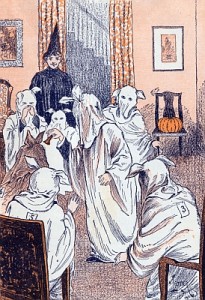
Both Hallowe’en at Merryvale and The Book of Hallowe’en offer up both informative looks at Halloween traditions from years gone by and unintentionally hilarious images, such as this fortune-telling session that looks disturbingly like a Klan meeting. Meanwhile, the racial stereotyping in “Halloween Failure” is just plain offensive. If I hadn’t already used it in this article, I could have also included a bizarre Halloween postcard about scarecrows wanting to go to heaven as well.

And that, dear reader, makes all that I could find for crazy Halloween stuff from years gone by. I’m afraid all my resources are tapped. That said, there is a question mark in the title for a reason, as I will still keep an eye out for more material in the hopes that I can do more installments in the series. Failing that, I hope this farewell of sorts and the previous entries in the series are enough to satisfy you:

Vintage Halloween Insanity
More Vintage Halloween Insanity
Still More Vintage Halloween Insanity
Modern Halloween…Sanity?

I might goof on Halloween articles from old issues of Popular Science in the last few Halloween countdowns, but I should be fair and show some modern examples of their material. After all, things are certainly much safer (and saner) nowadays, right?

Sadly, Halloween articles seem to be few and far between these days and what few they do publish are very short. This page from the October 2003 issue has a write-up about a nifty $50 motion sensing gadget that can record up to 20 seconds of sound effects. It’s a great all-in-one device for those who don’t want to build their own motion-sensing devices using plans found on places like the Monsterlist (which cost less and can be connected to a CD player so you can play longer clips).

The “Scare Tactics” article from the October 2006 issue has more meat on its bones despite the single-page length. The tutorial about how to make scary sound effects go off when a person walks by a certain area using a Mac laptop, webcam and a few downloads is very cool. The only remotely bad part (other than the seeming uselessness of the article to PC laptop owners) is the suggestion of where to download sound effects. I’m shocked that they don’t tell Mac owners to take advantage of the free sound effects available through imovie (which came free with most Mac products at the time of that article’s writing) rather than dump them onto some “free sound effects” site that was probably the first result in a quick web search on the matter. Since they didn’t do it, I will…link to a preview of Keith Underdahl’s Digital Video for Dummies that tells how to do so (which also tells how to record a few sound effects of your own).

But the three bonus “Haunted Hacks” at the bottom are a different story. The one about ripping off the face of a robotic chimp and using it as a creepy face mind sound crazy, but it’s not that bad of an idea. Just imagine how this would look in dim lighting. I know of a guy who did something similar with a modified, skinned Furby for a home haunt and the results were pretty creepy. Sadly, the instructions for turning an old laptop into a projector in order to cast horror movie scenes are far too short to be of any use and there are no warnings about handling or keeping people away from the dry ice fog necessary for the projections (dry ice can be dangerous, but nowhere near as dangerous as stuff from old-school Popular Science articles). Speaking of old-school Popular Science Halloween articles, the suggestion to mix liquid soap and liquid nitrogen to make a bubbling witch’s brew is a bizarre flashback to those days. I guess it really is true that the more things change, the more they stay the same.

Enter if you dare...

For the last two years that I’ve do this, I always think I’ve found the most dangerous and foolhardy Halloween how-to and will never find anything that will top it…only to then find something that does so. This year was no exception.

When I first read the “Mechanical Halloween Pranks” article from an October 1918 issue of Popular Science, I thought I wouldn’t have a good “Vintage Halloween Insanity” this year. The homemade lanterns were only somewhat unsafe, although use of a flashlight, LED or glowstick would make modern usage of the plans safe, while the window posters were fine. But just when I thought I had mined vintage Halloween stuff for all it was worth, then came the instructions for a witch’s cauldron scene. Although wisely telling the reader to only use real fire (and flame powder that produces colored bursts of light) outdoors, the “safe” indoor alternative of a light bulb covered by wads of tissue paper is anything but.

However, the star of this entry did not appear until I chanced upon an article called “A Halloween Chamber of Horrors” from the November 1916 issue of Popular Science. Not only is it worthy of note due to its dangerous ideas, but it’s also the earliest example of a haunted attraction that I know of, homemade or otherwise! The fact that such things existed in the early 1900′s must be a huge shock to home haunters and Halloween enthusiasts. Amazingly, this haunt was not simply a “blindfold someone and have them touch bowls full of icky-feeling items”-type deal. No, this was an honest-to-goodness walk-through attraction with several electrical effects!

The first page of the article details what one would see and experience if they had been at the haunt. Numerous “moderately severe shock[s]” are administered to visitors, with visible electrical sparks that even the writer noted would be dangerous to touch appearing at one point. Oh, and did I mention that visitors also have to kiss a baby’s skull? Don’t worry, it’s just a small fake. They weren’t THAT crazy back then. Still, I’m impressed that they came up with something that sick. Speaking of “sick,” I wonder how many diseases were contracted due to all those people kissing the same skull in the exact same spot?

The next page is filled with behind-the-scenes secrets, such as how patrons were hit in the face with raw meat and football bladders! The final page reveals more secrets, such as the use of a Crookes’ Tube (which give off cancer causing x-rays) for lighting and the use of live snakes. Said snakes (and bare skin) were covered in homemade glow-in-the-dark paint made from crushed match heads! Do I even have to explain why that’s a terrible, terrible idea? If the previous installments are any indication of the future, then I’m going to find one hell of an unsafe tutorial for the 2011 countdown…

Before I begin, I want to give some credit where it’s due. This post (and several of my other recent entries) would not have been possible if I hadn’t learned the joys of Google Books from Atomic Mystery Monster’s link-filled JREF posts.

Long-time readers will likely remember an entry from the first GdL Halloween countdown where I linked to dangerous Halloween ideas from an old issue of Modern Mechanix. After discovering that Google Books offered complete scans of Popular Mechanics and Popular Science, I decided to see if I could find any other oddball Halloween tips similar to the ones from 2008.

At first, it seemed liked the old dangerous and lawsuit-baiting ideas I discussed last year were a one-time only thing. This three page article on mask-masking from 1931 seems fine, as does this article about making a Halloween-themed rocking chair. Although many of the tricks noted here are quaint, they’re pretty safe for the most part.

But once I started reading scans from a November 1934 issue of Popular Mechanics, things started to go downhill. It starts off pretty well, but soon lapses into over-complication once they wheel out the smoking robot and tent costumes. Sure, the robot costume looks neat, but don’t expect any easy time getting out of it to use the toilet. As far as I’m concerned, the only really useful (and fairly easy) idea to be found in the article is the part about giving a costume glowing eyes.

But things got really crazy in the November 1935 issue, both in terms of the layout and suggestions. If you think tricking people into biting cakes of soap and electrically-charged nails sticking out of a chair are bad, wait until you hear this: The article actually suggests making “secret messages” appear using a hidden curling iron and sulfuric acid! I don’t care that they told people to use caution when handling it or that the acid should be diluted, why the hell did they think telling people to use sulfuric acid at a party would be a good idea? Did they forget that children and alcohol consumption tend to appear at parties, Halloween or otherwise? Did they forget that writing messages on paper with lemon juice and holding them over a lamp provides the same basic effect with much less effort and much greater safety? Then again, these are the people that recommend wiring up a Ford coil to a tin strip over a light bulb or creating a burning alcohol mixture in order to produce strange lighting effects, rather than simply using colored bulbs (or fireproof colored coverings placed over bulbs). Unsurprisingly, the simplest and safest ideas are saved for the end of the article. It’s amazing that people managed to survive Halloween in the thirties.

Now that I think about it, why on earth are they giving Halloween advice in their November issues? My first guess was that the magazine was bi-monthly, but the existence of October issues from that period prove that theory incorrect. Did Halloween used to occur in November back then? It would certainly explain why the protagonist of Betty Smith’s A Tree Grows in Brooklyn went trick-or-treating around Thanksgiving. Does anyone out there in readerland have an answer for me?

Here’s a scanned article from a 1934 issue of Modern Mechanix called “Thrills and Chills for your Hallowe’en Party.” Emphasis on “chills,” because there’s no way you could get away with 99% percent of those ideas without getting roped into a personal injury lawsuit.

Bad Behavior has blocked 1447 access attempts in the last 7 days.