"What is he that builds stronger than either the mason, the shipwright, or the carpenter?"
Header image

Jill Thompson is amazing. There’s no denying that her career as a cartoonist has produced some of the most fantastic spooky artwork out there. There’s both a playfulness in her line work and a genuine sense of creepy in her colors, making her a great example of how spooky and weird can be fun.

I first found her work through the ‘Scary Godmother‘ character back in a comic shop. The character, who she would list as a cross between a fairy godmother and a witch in the ‘Ghouls Out For Summer’ story, is joined by a list of spooky characters – Harry the Werewolf, Bugaboo the Monster-under-the-bed/in-the-basement and Mr. Pettibone the skeleton. Friends of a young girl named Hannah, Scary Godmother’s initial books are aimed more at the younger set. More spooky than scary, the collection is a great way for the young to get into reading. But for adults, Jill Thompson’s art is spectacular. Real crisp linework and vivid colors make each page a great sight to see and each reading shows something you didn’t see before. You can get the collected books here for a really great price.

For the more adult readers is her work with Evan Dorkin, the Beasts of Burden. The series details the continuing adventures of a group of animals first appearing in the Dark Horse Book of Hauntings (with a story in The Book of Witchcraft, The Book of the Dead, The Book of Monsters.) Showing how the animal world deals with the supernatural, it’s a great comic book.

Jill Thompson also does Magic Trixie, which I can’t front and say I know much about. But it seems to pick up with the whimsical supernatural adventures that left off with Scary Godmother. If ever I find myself near a comic shop this season, I’ll have to check it out – and I encourage you to, as well.

Follow Jill Thompson on Twitter and check out her official site here.

derf city has a lengthy Ghoulardi comic. You can read the rest of it here. Highly recommended, for both the artwork and the story.

While reading the excellent horror site Evilontwolegs.com, I learned of the artistic equivalent of the fabled Necronomicon, which only gets worse for your sanity the more you look at it. Here’s a quote hinting at the madness within:

“If you imagined Freddy impregnating Jason, you’d probably think that this a completely original, albeit bizarre, idea. Sadly, you’d be wrong.”

Click here if you have the nerve (or is that foolishness) and prepare to feel rage (some content might be somewhat NSFW).

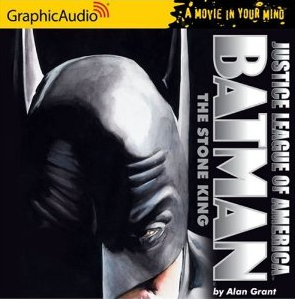
From his appearances on The Adventures of Superman radio show to the numerous “record/tape and comic” releases, Batman has always had a rich history in the world of audio dramas. The latest company to contribute to this legacy is Graphic Audio, with their series of adaptations of novels starring DC comics characters. Some of his appearances are as part of major crossovers, some are solo adventures and the Justice League of America dramas have him as a supporting cast member. Said dramas tend to focus on a single League member, although others argue that these are just JLA stories with a single member promoted on the cover. In this case, I’ll be looking Batman: The Stone King, based on the novel of the same name by Alan Grant.

Why is a horror website reviewing a comic book themed audio drama? Well, let’s look at the plot: a mysterious pyramid is unearthed in Gotham City in the aftermath of a dam burst. Said pyramid is filled with symbols associated with black magic. Needless to say, an ancient evil is unleashed and Batman is the only Justice League member left uncaptured as the entire world is in peril. Horror fans might also appreciate the interesting insights on the nature of fear that are sprinkled throughout the plot. Be warned, as there are minor spoilers ahead…


Batman: The Stone King, is definitely not something you can play for kids (like the above-mentioned record sets). People die (often in gruesome ways) and the gory events are described in graphic detail. Parents probably wouldn’t want the little ones to hear the flashback to two characters having sex, either. It’s nothing explicit (and only lasts seconds since the characters get interrupted), but still.

Although the idea of a non-powered superhero taking on a supernatural foe that managed to defeat the likes of Superman and Wonder Woman might seem outlandish at first, the story actually handles it in a believable manner. I won’t spoil Batman’s plan, but I will note that it takes advantage of the fact that the disembodied shaman needs a human host.

I enjoyed the way the Stone King is handled. Rather than immediately springing into action the second the pyramid is unearthed, Grant wisely chose to have the villain remain inactive until his chamber is disturbed. Similarly, the Stone King uses his powers to test each League member’s abilities before making his move. Even after he’s captured everyone but Batman, he doesn’t rush into his plan to “cleanse” the planet and instead makes sure everything he needs is in place.

Although the JLA does play a good-sized role and each member gets a “chapter” dealing with the Stone King’s test of their strengths and weaknesses, this is still Batman’s show. Most of the plot is about him and it’s his plan that ends up saving the day. Not having read any comics since the mid 90′s (and I was pretty much a “Marvel Zombie” then anyway), I can’t offer much insight as to the characterization of the heroes other than what I’ve gleaned from their TV and film appearances. Everything seems fine to me in that department. There are a few minor plot holes, but they’re nothing too major. For example, the old sewer Batman travels through at one point should have been destroyed in the major earthquake that struck Gotham (which is even mentioned in the drama).

However, there were other occasions when the seeming errors actually weren’t. There were times I thought “I don’t care if the Flash was caught by surprise, he shouldn’t almost get punched by a normal person” or “There’s no way Wonder Woman would have trouble handling a group of zombies,” only to find out later in the story that the Stone King grants superpowers to those he controls.

But let’s get to the question on everyone’s mind: how well does this work as an audio drama? After all, comics are a visual medium and a novel is already one step away from that. Some parts worked better than others and some aspects took awhile for me to get used to, but all in all I’d say it was a good ride. Graphic Audio’s “Movie in Your Mind” format is a hybrid of an audio book and an audio drama: A narrator describes the action while actors perform characters’ dialogue, combined with music and sound effects. Having first been exposed to the H.P. Lovecraft Historical Society’s The Shadow Over Innsmouth audio drama, it took me quite some time to get used to this. I suspect this won’t be as much of an issue for you if you have either only heard audio books or have never listened to audio books or dramas. I found that doing something else while this played in the background or listening while feeling a little tired made it easier to visualize the story. The music and effects were all top notch; I’d gladly pay for a soundtrack CD. Judging the voice acting is hard in the sense that the “right” or “wrong” voice for a character depends upon the listener. In my opinion, the only truly wrong voice was the one used for Commissioner Gordon, as it would seem more appropriate for a comic relief character. This is in terms of the voice only, each one of 27 cast members were great actors/actresses. I thought the voices used for Wonder Woman, the Flash and Martian Manhunter were great. I was unsure about the ones used for Batman and Superman, but I got used to them after awhile. However, if Superman is supposed to be an older, world-weary version of the character, then the portrayal here is dead-on perfect. The titular Stone King sounded very creepy and menacing, although the effect is occasionally spoiled in the (rare) instances when he briefly lapses into a vaguely Russian accent. But otherwise, he’s very scary. “Terrify your friends by suddenly turning off the lights and playing one of his rituals” scary. Do not let my attempts at being thorough fool you into thinking that I disliked Batman: The Stone King. On the contrary, I had a great time listening to it and I have far more problems with the sleeves used to store the discs than I do with any aspect of the drama itself. If anything, this release has increased my enthusiasm for audio dramas! Getting back to the sleeves, I wish they had included a hole of some kind on the top side in order to make it easier to remove the disc inside.

Speaking of discs, the story is spread out over six discs, with a running time of about an hour per disc. The long running time is due to both the drama being unabridged and because the company’s target audience is largely made up of people on long road trips. Speaking on someone who has been on many a long, boring vacation drive, this makes perfect sense to me. Come to think of it, I could have easily polished off a disc per day during my old commute. If the thought of swapping discs doesn’t sound appealing, Graphic Audio also offers both a single disc “.mp3 CD” version and an .mp3 download. I should also note that the multiple disc editions use CD-Rs, presumably to keep the cost of a multiple disc release under twenty dollars. They are not unauthorized bootlegs, as they’re licensed by DC Comics. These are professionally done CD-Rs with metallic tops and the title printed on them, so don’t expect some homemade job with stuff written on in marker.

I definitely recommend checking this (and other audio dramas) out and hope you’ll at least listen to the preview for it. Horror fans might also be interested in Justice League of America: The Exterminators, The Flash: Stop Motion and the upcoming DC Universe: Trail of Time (wherein Superman teams up with a variety of supernatural and western-themed characters, including Etrigan the Demon and Jonah Hex). Or for those who prefer non-comic book horror, there are titles like The Destroyer: Deadly Genes and The Demon Wars Saga.

Special thanks to Graphic Audio for the review copy!

Ah, Free Comic Book Day. A day of free comics and special sales at numerous comic book stores that falls on the first Saturday in May of each year. 2010 marks the 9th annual celebration of the event since its creation in 2002.

Although past installments have carried horror-related titles and there are plenty of tie-ins between comic books and horror, but comic stores deserve our support for also carrying horror magazines, trading cards, models, DVDs, etc.

For more information, please visit the official website and its Wikipedia entry. That’s where we learned something that should be of interest to our German readers: they’re getting their own version of the holiday on May 8th!

Don’t forget, tomorrow is Free Comic Book Day 2010! That’s right, comic shops all over America are giving away free comic books and having special sales on May 1st. Don’t miss out on this!

What do Godzilla vs. Megalon and Leprechaun both have in common? They both had short promotional comic books released during their theatrical runs! And if you guessed that the Leprechaun comic was riddled with as many inaccuracies as the Godzilla vs. Megalon comic, you’re absolutely correct.

It should also be noted that there was a Leprechaun comic book series published in 2008 by Blue Water Productions. The series, which involved the Leprechaun traveling the world to recover his lost gold, ceased publication after four issues. This Wikipedia entry provides more plot details, along with notes on a never-released comic crossover battle between Warlock and Leprechaun. That’s probably for the best, as the only thing each series have in common are that they are both linked to Trimark.


Happy St. Patrick’s Day! 

It just occurred to me just how much Marvel Comics seems to have been influenced by the horror genre when it came to creating some of their superhero characters. And no, I’m not talking about how many of them either made their debut in or had stories published in former horror/sci-fi comics such as Tales of Suspense, Journey into Mystery, Strange Tales, Amazing Fantasy, and Tales to Astonish.

Sure, it’s pretty obvious how certain horror stories influenced the Incredible Hulk. Dr. Banner’s (usually) unwilling transformation into the destructive force that is the Hulk nicely mirrors Dr. Jekyll’s relationship with his Mr. Hyde persona. Like Universal’s take on Frankenstein’s monster, the very large and very strong Hulk often comes into conflict with people who deal with things they fear (and don’t understand) by attacking them. Like Frankenstein’s monster, the Hulk’s limited intelligence and speaking abilities also impede his efforts to find peace. Those factors might also explain why both have befriended small children.

However, what you might not know is that the Hulk’s origin story seems to be lifted from The Amazing Colossal Man (which came out about five years before the first issue of the Hulk’s comic book). Think about it: both involve a scientist being mutated due to exposure to an experimental bomb blast while trying to rescue the driver of a vehicle stranded in the test area! Come to think of it, I wonder if the name “The Amazing Colossal Man” could have influenced Marvel’s decision to add adjectives to the titles of many of their superhero titles (The Amazing Spider-Man, The Uncanny X-Men, etc).

Even those without much knowledge of the character can tell that Dr. Henry Pym (aka Ant-Man) is based on The Incredible Shrinking Man. The influence become more apparent when one realizes that Dr. Pym made his debut in a science fiction story called “The Man in the Ant Hill” in 1962, wherein he is accidentally shrunk in an experiment and has to battle ants in order to survive. By his next appearance, Pym has mastered the ability to change size and created a device that lets him communicate with his former foes.

Also, is it merely a coincidence that both the Mighty Thor’s alter ego and the title character in Monster on Campus are both named Dr. Donald Blake? Pat yourself on the back if you guessed that the horror movie came out years before Thor made his first appearance!

But this (seeming) influence also works in reverse. The monster costume used in 1962′s Hand of Death was a blatant rip-off of the ever lovin’ blue-eyed Thing, right down to the trench coat and sunglasses disguise used when both characters try to blend in with the general public. I must admit to originally thinking the Thing was the rip-off until I took the time to research the year the first issue of the Fantastic Four was published: 1961. Now if only I could get a definitive answer as to whether Full Moon’s Doctor Mordrid was originally planned as a licensed adaptation of Doctor Strange or if it was just a shameless rip-off…

Jack Chick, that is. For those not in the know, Mr. Chick is infamous for creating little illustrated booklets (popularly known as “Chick tracts”) that claim you’ll go to Hell if you don’t follow his particular interpretation of Christianity. If you go to his website, which I’m not linking to for obvious reasons, you’ll even see that he advises passing out his tracts with candy on Halloween in order to “save” children from the holiday.

Enterthejabberwock.com has done several examinations of Chick’s work that humorously and informatively tear apart the numerous flaws in his arguments, storylines, and artwork in a NSFW manner. I especially love the dissections of the Halloween-themed tracts, the first of which is called “Here, Kitty Kitty!” and deals with evil knock-offs of the Peanuts gang who want to sacrifice a cat on Halloween.

The next tract is “The Devil’s Night” and Chick’s terrible research skills are glaring in this one. Not only does he completely botch the spelling of “Samhain,” but he also fails to realize that pumpkins weren’t even used the way he claims they were back then. If Mr. Chick can’t even get those simple details correct, why should he expect anyone to believe any of the other “facts” in his work?

The final one is called “Boo!”, a failed attempt at a horror movie parody. It’s slightly more accurate than “The Devil’s Night,” but it still provides a wildly inaccurate take on the origins of Halloween. I’ve heard that Jack Chick recently released another Halloween-themed tract and I can only hope it gets the Enterthejabberwock treatment sometime soon.

UPDATE: The dissection of the newest Halloween tract is now up. “First Bite” is Jack Chick’s attempt at a campy vampire story. As you can imagine, the results aren’t pretty.

Bad Behavior has blocked 1447 access attempts in the last 7 days.