10/5/12

It was a dark and stormy night…

SHAZAM!

Longtime readers may recall that, in our last installment, I noted how the phrase “It was a dark and stormy night” was coined by the author of The Haunters and the Haunted. The phrase has turned up in countless horror stories, like “The Monkey’s Paw,” and I have decided to pay tribute to that fact by offering a collection of stories that are well-suited for reading on such a night.

Naturally, such a theme wouldn’t be complete without some stories influenced by the masters of the horror genre. Greg Chapman’s short story collection Midnight Theatre features a Poe-inspired tale called “Patrick Oswald Edwards” while Mike Minnis’ “The Girl Who Walked in Circles” is very Lovecraftian. Also, both “The Mysterious Card” and “The Mysterious Card Unveiled” by Cleveland Moffett are highly influenced by Robert W. Chambers’ The King in Yellow.

The Amazon preview for Hell Comes to Hollywood features Laura Brennan’s unique take on a ghost story called “Message in a Bottle.”

Similarly, the Google Books preview of The Year’s Best Fantasy and Horror, Volume 7 yields gems like Charles de Lint’s “Dead Man’s Shoes” and “The Lodger” by Fred Chappell.

Those seeking a (comparatively) more traditional lodger story should seek out “The Basket” by Herbert J. Mangham.

The internet can be a terrifying place, as demonstrated by Dwight McPherson’s “The Deathly Tweet” and the NSFW tale “Links” by Kurt Newton.

Ralph Adams Cram offers up a spine-chilling tale of what happens to two friends when they travel through “The Dead Valley.”

I’m sure many of you reading this have fond memories of Scary Stories to Tell in the Dark by Alvin Schwartz. Now you can relive them by reading the following selections from said book: “Wait Till Martin Comes” and “The Attic.”

“The Noseeums” by Jeremy Russell offers an interesting (and creepy) explanation for why ghosts are almost always seen in buildings.

Remember Strange Jason’s review of Arcane magazine? Well, the same publisher is offering all five issues of Arkham Tales for free!

Ambrose Bierce is famous for his tales of the supernatural and the fantastic, and “The Moonlit Road” easily demonstrates why this is the case.

Robert Anton Wilson once said that his “Schrödinger’s Cat trilogy” was not a “Shaggy shoggoth story.” Besides being an amusing play on the traditional “shaggy dog story,” I think the term is perfect for describing “The Seven Geases” by Clark Aston Smith and “The Descent into the Abyss” by Lin Carter.

Last but not least, Jeremy C. Shipp has a huge assortment of free horror stories available on his website.

04/30/12

Almost Horror, Not Quite

Have you ever read a story that, although it had the right elements to be a horror story, didn’t feel as though it fully fit into the horror category? I’ve had that experience many times while searching for content for this website and what convinced me to do this article was Maurice Leblanc’s The Secret of Sarek (aka Coffin Island). When I first started reading it, it seemed like it was going to turn out to be a 1920′s version of The Wicker Man (or maybe I should cite the film’s literary inspiration instead), but the ending of the novel proved me wrong. Don’t get me wrong; it was a great read. It was just not what I originally expected it to be. Here are all of the stories I’ve come across over the years that fall into this unique situation:

“The Open Window” by Saki
“A Ghost Story” by Mark Twain
“A Predicament” by Edgar Allan Poe
The Secret of Sarek by Maurice Leblanc
“The Birth-mark” by Nathaniel Hawthorne
“The Mummy’s Foot” by Théophile Gautier
“The Bottle Imp” by Robert Louis Stevenson
“John Mortonson’s Funeral” by Ambrose Bierce
“Trilby and the Ghost” by Ben ‘Yahtzee’ Croshaw

As you can, see the majority of authors noted above are known for their horror stories, so their work here is even more interesting as a result. Poe’s story, which was originally published as “The Scythe of Time,” is notable for its companion piece “How to Write a Blackwood Article,” another humorous work by Poe that mocks the generic horror yarns that often appeared in Blackwood’s Magazine. Twain’s tale is based on the events noted here (NSFW) and Ben ‘Yahtzee’ Croshaw is also responsible for “Zero Punctuation” and the story has a loose connection to his “Chzo Mythos.” I should also note that while most of the works above are in the public domain, Mr. Croshaw’s story is copyrighted and won’t become PD for a looooong time.

11/30/11

The King in Yellow

Where flap the tatters of the King...

“Along the shore the cloud waves break,
The twin suns sink beneath the lake,
The shadows lengthen
In Carcosa.

Strange is the night where black stars rise,
And strange moons circle through the skies
But stranger still is
Lost Carcosa.

Songs that the Hyades shall sing,
Where flap the tatters of the King,
Must die unheard in
Dim Carcosa.

Song of my soul, my voice is dead;
Die thou, unsung, as tears unshed
Shall dry and die in
Lost Carcosa.”

The evocative words above have undoubtedly sent chills down the spine of many a reader. They’re said to be from Cassilda’s Song in “The King in Yellow,” Act I, Scene 2. I say “said to be” since the play doesn’t actually exist.

Back in 1891, Ambrose Bierce wrote a short horror story called “An Inhabitant of Carcosa,” along with a 1893 story called “Haïta the Shepherd” that made a passing reference to a god of shepherds called “Hastur.” Fellow author Robert W. Chambers decided to pay tribute to him in 1895 by including uses of the terms “Carcosa,” “Hastur,” and “Hali” (a philosopher noted in “An Inhabitant of Carcosa”) in his anthology, The King in Yellow. While Carcosa was used as the name of a city in the novel and Hali became the name of a lake, the use of Hastur in it was far more complicated. In the story “The Repairer of Reputations,” Hastur was the name of a location despite it being given as the name of a character in “The Demoiselle D’Ys.” On top of that, the name is used several times throughout the anthology without explanation, although some think it is meant to represent a star. The idea behind The King in Yellow is that most of the stories involve characters reading or discussing the play “The King in Yellow,” while others seem to treat elements from the play as being real, such as the King in Yellow or the Yellow Sign. Other stories feature samples from the nonexistent play, which in the story is said to induce madness due to its harsh truths about universe.

Such a work of horror naturally caught the attention of H.P. Lovecraft, who incorporated references to Hastur, the Lake of Hali and the Yellow Sign into “The Whisperer in Darkness” in 1930 (which was not published until 1931). I know what many of you are thinking: “Ah, so Lovecraft’s inspiration for the Necronomicon was “The King in Yellow!” The thing is, that’s not the case at all. The Necronomicon first appeared in “The Hound,” which was written in 1922 and published in 1924 while Lovecraft didn’t read Chambers’ work until 1927!

But what about Hastur the Unspeakable’s connection to the King in Yellow, you might ask. After all, lots of Cthulhu Mythos stories connect the two and tentacled beings in tattered yellow robes are a staple of Lovecraftian merchandising and gaming. What about those stories? The thing is, Lovecraft never wrote them! The creation of Hastur the Unspeakable is due to one August Derleth. It seems that Derleth was quite taken with the Hastur reference in “The Whisperer in Darkness” and, seeing how Lovecraft had seemingly done little to develop “Him Who is Not to be Named” (aka “He Who is Not to be Named”) in his stories, decided to expand upon the concept himself by combining the two. This led to him penning “The Lair of the Star Spawn” with Mark Shorer in 1932, which featured Hastur’s first appearance as an entity in the Mythos. Things were fleshed out further in his 1937 tale “The Return of Hastur,” which introduced the idea of Hastur being related to Cthulhu (he also introduced his infamous “Good vs. Evil” variant on the Mythos in the same story). What Derleth apparently didn’t realize was that, despite Lovecraft focusing more on the character in his letters rather than his stories, Hastur and Magnum Innominandum (which roughly translates as “Him Who is Not to be Named”) are listed as two separate things in “The Whisperer in Darkness!” Despite this, Lovecraft never went out of his way to stop Derleth’s interpretation of the character. The only time he put his foot down was when Derleth wanted to refer to what is now known as the Cthulhu Mythos as the “Hastur Mythos!” In all fairness, though, Lovecraft alternated between seemingly implying that Yog-Sothoth and He Who is Not to Be Named were one and the same while listing them as separate beings in private correspondence. It’s also worth noting that in his short story “History of the Necronomicon,” Lovecraft has Chambers being inspired to write “The King in Yellow” due to the Necronomicon!

What about the mysterious high priest whose face is hidden behind a yellow silken mask that appears in Lovecraft works like “Celephaïs,” “The Dream-Quest of Unknown Kadath” and “Fungi from Yuggoth?” Given that it is known as both the “High-Priest Not To Be Described” and “veiled king,” the high priest seems like a good King in Yellow candidate. But, given that the first two works were written in 1920 and 1926 (with the 1929 poem merely referencing those past works), it is impossible for Lovecraft to have based the character on Chambers’ creation. That hasn’t stopped people from linking the two, though. Some claim that the yellow-clad Dreamlands avatar of Nyarlathotep is actually the High Priest.

In addition to Chambers, Lovecraft and Derleth, numerous other writers have paid tribute to the King in Yellow in their work. Famed crime fiction author Raymond Chandler even included a reference to it in his short story “The King in Yellow,” in which the protagonist remarks that a murdered man in torn yellow pajamas reminds him of a book he once read! Although most of these works are unable in complete form online, I did manage to find two works to further complement the above-linked stories and prose. First is Lin Carter’s “The Candidate,” a selection from his poem “Dreams from R’yleh” that combines the “High-Priest Not To Be Described” and the King in Yellow. “To Every Thing There Is A Season” by Dru Pagliassotti uses the Hastur interpretation of the King in Yellow in a humorous tale involving Deep Ones. Perhaps the most prolific writer in the field of “The King in Yellow” tributes is Joseph S. Pulver, who has written 30 such works so far. You can learn more by visiting his website.

11/22/11

Even More Vile Verses

Maybe that "solo XP" idea wasn't so wise after all...

After doing two lengthy installments in the “Vile Verses” series, I had foolishly thought I had found all of the spooky poems I could ever find in my last entry. However, the recitation of Lewis Carroll’s “Jabberwocky” in A Nymphoid Barbarian in Dinosaur Hell made me realize there was still plenty of material out there. In addition to digging up “Jabberwocky,” I also discovered that Lewis also did another spooky poem called “Phantasmmagoria.”

Speaking of authors whose work has been beloved by children, Ogden Nash has done his fair share of poems with creepy touches, such as “The Wendigo” and “The Tale of Custard the Dragon” (one of my favorite bedtime stories as a child).

Another poem from my youth is “Little Orphant Annie,” which my my late grandfather often recited for me. While the name might not seem scary or even make grammatical sense, reading the poem (and its Wikipedia article) will explain everything. That last article also notes how the poem was based on true events from the author’s life. Given that both the author and inspiration for Annie are Caucasian, the use of “Mammy” seems to be part of the poem’s attempt at capturing a regional dialect rather than reference offensive stereotypes.

Cry of the Banshee is an odd case. Although the film was claimed to be an adaptation of a poem by Edgar Allan Poe in publicity materials, no work by Poe with that title exists. The film was also promoted with this short poem, but it cannot be found among Poe’s works. Research led to a play of the same name (written long after the film was released) that quoted a supposed Poe work, but further research revealed that said work doesn’t seem to exist! So was AIP telling a bald-face lie by claiming the film had a Poe connection? Not exactly, as they did insert a select few lines from Poe’s “The Bells” in the film’s opening, similar to what they had done to turn The Haunted Palace and The Conqueror Worm into “Poe films.”

Speaking of films and poems, Pumpkinhead is said to be based on a poem by one Ed Justin, which you can read here. While the article casts doubt on this due to its apparent unavailability prior to the film, this doesn’t necessarily mean it wasn’t based on a real poem. For example, the story “The Greatest Gift” wasn’t published until long after it was filmed as It’s a Wonderful Life (said story is a major reason why the film was found to not truly be in the public domain) and Sopranos creator David Chase’s unpublished novel Still Life was adapted into Grave of the Vampire.

Not only is Bertolt Brecht’s “The Swamp” full of creepy imagery, but it’s also inspired by horror legend Peter Lorre!

Speaking of inspirations, both the title and plot elements of Suspiria were influenced by Thomas De Quincey’s prose poem “Suspiria de Profundis” (which translates as “Sighs from the Depths”). Here is an extract from it featuring the part which captured Dario Argento’s imagination the most, “Levana and Our Ladies of Sorrow.”

Although best known for “The Rime of the Ancient Mariner,” Samuel Taylor Coleridge has also penned scary works like “Phantom,” “Christabel” and “Sonnet: To The Autumnal Moon.”

Wikisource also gives us works by Nicholas Vachel Lindsay, like his Poe tribute “The Wizard in the Street” and “Ghosts in Love.” Speaking of ghosts, Ella Wheeler Wilcox uses them as a metaphor in “Ghosts,” Robert Brooke discusses “Hauntings” and James Russell Lowell tells us of “The Ghost-Seer.”

Stephen Crane is no slouch in the eerie poetry department, having given the world “Behold, The Grave of a Wicked Man,” “Mystic Shadow, Bending Near Me” and “Black Riders Came From the Sea.”

Kaiju haiku. It both rhymes and makes a great deal of sense, given both are Japanese. You can read numerous example of it here.

Google Books brings us numerous works by modern day poets, such as Glyn Maxwell’s “Haunted Hayride” and “The Man Who Held His Funeral.” It also offers a look at the famed horror magazine Weird Tales, which provides us with poems like Nancy Springer’s “Fear,” Lynne Armstrong-Jones’ “Bewitching Lessons” and Ann K. Schwader’s “Moot Question.”

Famed science fiction writer Ray Bradbury is no stranger to the world of poetry, haven written poems like “Which Shall It Be” (his tribute to H.G. Wells) and “Revivere, Rex!”

The preview for Adam Rex’s Frankenstein Makes a Sandwich not only has the titular humorous poem, but also ones about the Creature from the Black Lagoon and the Phantom of the Opera. Tera Chaney’s Poetry of the Vampire has just what you’d expect in it.

Yellow Rider and Other Fantasy Poems features many poems by Steve Eng, like “Grey Skater,” “May-Eve,” “Haunted Heritage,” “Vaingloria,” his translation of Guy de Maupassant’s “Memories,” “Destination,” “Below the Horizon” and All Hallow’s Eve.”

Finally, there’s also “A Poet’s Epitah” and “The Witch-Bride” by William Allingham, “Goblin Market” by Christina Georgina Rossetti, “Halloween” by Gjertrud Schnackenberg and the unusual “The Vinegar Man” by Ruth Comfort Mitchell.

10/1/11

Scary Stories

SKULL!

What better way to get into the Halloween season than by reading scary stories? Our first selection is Robert Louis Stevenson’s classic Strange Case of Dr Jekyll and Mr Hyde (which is the source of the above image). He also wrote “The Body Snatcher,” which was later adapted into the classic Val Lewton movie of the same name.

What is the the strange secret of “The Room in the Tower” by E.F. Benson?

Although better known for The Lost World and his Sherlock Holmes stories, Arthur Conan Doyle was no slouch in the horror department. “The Horror of the Heights,” “The Terror of Blue John Gap” and “Lot No. 249″ are great examples of this.

Montague Rhodes James, often known simply as “M.R. James,” is considered to be the master of ghost stories in Britain. After reading “Oh Whistle, and I’ll Come to You My Lad” and “Count Magnus,” I think you’ll agree.

William Mudford’s “The Iron Shroud” (aka “Italian Revenge”) is an interesting tale of torture that supposedly influenced Edgar Allan Poe’s “The Pit and the Pendulum.” Wikipedia also notes that it was a major part of an old Popular Mechanics article about torture chambers!

Similarly, “The Air Serpent” by Will A. Page was referenced in an issue of Eerie as an example of real folklore!

Wardon Allan Curtis’ “The Monster of Lake LaMetrie” is a bizarre tale involving a brain transplant and an Elasmosaurus! If you ever read The League of Extraordinary Gentleman and wondered what all the references to a talking lake monster were about, then you definitely need to read this.

“In Kropfsberg Keep” by Ralph Adams Cram is one of my favorite ghost stories, which is about two young thrill-seekers in Germany who spend the night in a haunted castle in the hopes of seeing the hanging ghost of the deceased owner.

“The Haunters and the Haunted” (aka “The House and the Brain”) is notable both due to its author, Baron Edward Bulwer-Lytton (who coined the phrase “It was a dark and stormy night”), and because it has one of the most bizarre endings in the history of horror literature.

Fans of H.P. Lovecraft will no doubt be interested in Elizabeth Bear’s “Shoggoths in Bloom.” Interestingly enough, it won the 2009 Hugo Award for Best Novelette.

The Invisible Man isn’t the only invisible character in the world of horror. Guy de Maupassant’s “The Horla” and Ambrose Bierce’s “The Damned Thing” both deal with monsters that can’t be seen with the naked eye. What adds to the creepy factor of “The Horla” is that it was written while its author’s mental state was suffering due to his contracting syphilis.

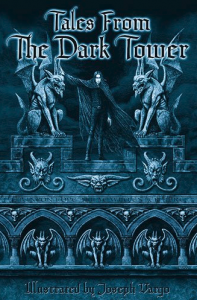
Although better known for his musical and artistic work with Nox Arcana, Joseph Vargo is also a talented author. The Amazon preview for The Legend of Darklore Manor and Other Tales of Terror (a tie-in with the album of the same name) features two stories, “The Coroner” and “Black Heart.” Although the first one was co-written with Joseph Iorillo, the second story is pure Vargo.

Back before he wrote Under The Dome, Stephen King was toying with the idea of trapped people in an unpublished story called “The Cannibals.” In order to help promote the release of
Under The Dome, he released his original attempt at the story online.

For more tales of terror, check out these classic Gravedigger’s Local 16 articles:

Storytime!
Tales of Cthulhu
A Study In Emerald
Have I got a story for you…

05/30/11

More Vile Verses

I'm here because the real artwork for "The Goblin Market" didn't fit GdL16's standards.  That, and because I'm so darn cute!

Since my last article about horror poetry turned out so well, I decided to revisit the subject. Wikisource has once again proven its usefulness to me thanks to its wealth of material. For example, I was able to find Christina Rossetti’s controversial “The Goblin Market,” James “B.V.” Thomson’s famous “The City of Dreadful Night,” Robert Burns’ “Halloween” and Nathaniel Hawthorne’s “Go to the Grave” there. Famed poet Henry Wadsworth Longfellow’s “Haunted Houses” and “Haunted Chamber” were there, as well as Don Marquis’ “Haunted” and “A Nightmare.” The works of Charles Baudelaire were also well represented by the somewhat NSFW “A Carcass,” “The Litanies of Satan” and “The Sick Muse.” Finally, Robert Southey’s “The Devil’s Walk” and “The Funeral” caught my interest. However, I had to go to Google Books to find Southey’s “To Horror” (which sadly features some politically incorrect content).

Google Books also yielded quite a lot of poems with spooky subject matter, like “Monday’s Troll” from Cobwebs, Chatters, and Chills: A Collection of Scary Poems by Patricia M. Stockland and “What Should I Be?” from Skeleton Bones and Goblin Groans: Poems for Halloween by Amy E. Sklansky and Karen Dismukes. The preview for Halloween Night by Charles Ghigna and Adam McCauley gives us “My Secret List,” “What to Wear on Halloween?” and “Costume Crazy.” However, things get decidedly more mature with poems like Jane Yolen’s “Knives” (based on “Cinderella”) and Donna Taylor Burgeess’ NSFW “Eat.” The adult nature of David Galef’s “Siren” should be of no surprise, given that it’s from the infamous Horror Between the Sheets. That said, Mark McLaughlin’s “The Titterer in the Twilight” is from the same anthology despite the lack of explicit content.

Amazon also offers numerous free book previews. I personally recommend checking out the ones for The Kingfisher Book of Scary Poems, Scary Poems to Make You Shiver, Delightfully Depressing Dark Poems, An Eyeball in My Garden: And Other Spine-Tingling Poems and The Graveyard Poet: Dark Adult Poems Of Horror, Madness and Death.

Although better known for his short stories, alt.horror.cthulhu regular James Ambuehl has also tried his hand at poetry. Works of his like “The Seed From the Stars,” “The Ballad of Black Bart” and “Following in Pickman’s Footsteps” can be found here.

Although you’ll have to sign into your Gmail/Google Groups account to see them, other poems can be found at alt.horror.cthulhu. Some ones that I found during my last trip there include “Old Ctharaths” by “Simon,” Thom Brannan’s “Unquiet Dreams,” “A poem dedicated to an unidentified supernatural entity” by Peter Vorobieff and “They Await” by “Special Agent Cooper.”

For more horror poetry, please visit:

Scary Poems

Gorelets.com

Scary Poems – Bedtime.com

Scary Poems by Richard Macwilliam

Scary Poems and Stories – Things That Go Boo

03/26/11

Vile Verses

OH MY![/Takei]

Whenever the phrase “horror fiction” is brought up, the mind invariable turns to stories. But what about poetry? It too is a form of fiction and a poem could just as easily have a horror theme instead of the expected ode to nature or romance. After all, one of the greatest literary works in the world of horror is Edgar Allan Poe’s poem “The Raven.” With that in mind, let’s look at some spooky poems by both well-known horror authors and lesser-known writers.

Although best known for his weird tales, Clark Ashton Smith has written numerous horror-themed poems including “Medusa,” “The Eldritch Dark,” “Nightmare” and many more.

Similarly, while Robert E. Howard is famous for being the creator of Conan the Barbarian, he also wrote a poem called “A Song of the Werewolf Folk.”

Michael Fantina’s “Night Terrors” is a must-read, as is Edith Wharton’s “A Grave.”

The Amazon preview for Vicious Verses and Reanimated Rhymes: Zany Zombie Poetry for the Undead Head offers Adam Huber’s “Isabella” and Kyle Hemmings’ “I, Zambi.”

Although his wife is famous for writing Frankenstein, Percy Bysshe Shelley has written some macabre works of his own. If “The Devil’s Walk” isn’t to your liking, perhaps one of his two poems about death will?

Shelley’s friend Lord Byron also dabbled in poetry with ghastly themes, such as the apocalyptic “Darkness” “Lines Inscribed Upon a Cup Formed From a Skull.”

In addition to “The Raven,” Edgar Allan Poe composed “The Conqueror Worm,”The Haunted Palace,” “Spirits of the Dead” and “Lenore.”

H.P. Lovecraft was very fond of Poe’s work, writing both “The Poe-ets Nightmare” and “Where Once Poe Walked” in tribute to him. He also wrote eldritch poems including (but not limited to) “Fungi from Yuggoth,” “Nemesis,” and “Astrophobos.”

You might remember Nick Mamatas from this entry about free online Cthulhu stories, which included his novel Move Under Ground. Mamatas took the various mythos-themed senryu sprinkled throughout the novel to form the chapbook Cthulhu Senryu. The Google Books preview of it offers several of these humorous, occasionally NSFW Japanese-style poems for you to enjoy.

It’s probably safe to say that most of the people reading this are more familiar with Japanese haiku than they are with senryu. The Wikipedia entry for Scifaiku both defines and provides examples of this special form of haiku. Also, Ryan Mecum has written vampire, zombie and werewolf-themed haiku that you can read thanks to the free previews at Amazon.

For more horror and science fiction poetry, please visit:

AuthorsDen
HorrorPoetry
Lil blog of Horrors
Science Fiction Poetry Association

03/17/11

The Banshee’s Halloween

It’s Saint Patrick’s Day here at the local again and I thought it best to take a break from the usual Leprechaun franchise related posts this year. Instead, let’s read a selection from Irish-American author Herminie Templeton Kavanagh’s novel Darby O’Gill and the Good People called “The Banshee’s Halloween.”

Although the Irish (and horror) connection is obvious, some might question the use of a story about Halloween on St. Patrick’s Day. However, the story itself explains why it’s a-okay:

“Halloween night, to all unhappy ghosts, is about the same as St. Patrick’s Day is to you or to me— ’tis a great holiday in every churchyard. An’ no one knew this betther or felt it keener than did Darby O’Gill, that same Halloween night, as he stood on his own doorstep with the paper of black tay for Eileen McCarthy safely stowed away in the crown of his top-hat.”

As you have probably guessed, the classic Disney film Darby O’Gill and the Little People was based on Herminie Templeton Kavanagh’s Darby O’Gill tales. However, the film’s banshee differs greatly from the one in this particular tale. In fact, I have heard that the film drew most of its material from the second book, The Ashes of Old Wishes and Other Darby O’Gill Tales.

Happy St. Patrick’s Day!

01/24/11

Tales of Cthulhu

Iä! Iä!

Cthulhu is an interesting case in the world of horror literature. Although easily the most popular of Lovecraft’s creations, so much so that the Lovecraftian interconnected literary universe is referred to as the Cthulhu mythos, he actually doesn’t make many actual appearances in the bulk of mythos tales. In H.P. Lovecraft’s original stories, Cthulhu only appears once in “The Call of Cthulhu,” then is only referenced in other stories. The closest thing to another physical appearance is the account of the star-spawn of Cthulhu’s battles with the Elder Things in “At the Mountains of Madness.”

The reason for Cthulhu’s scarcity is most likely due to both Lovecraft’s preference to suggest horror rather than show it outright and the phrase “Ph’nglui mglw’nafh Cthulhu R’lyeh wgah’nagl fhtagn.” Those who have read the “The Call of Cthulhu” know that it means which translates as “In his house at R’lyeh, dead Cthulhu waits dreaming.” As a being who can only awaken “when the stars are right” to destroy the world as humanity knows it, it makes little sense to have Cthulhu constantly awakening. Having a human protagonist repeatedly defeat him would destroy all sense of the Great Old One’s menace and having Cthulhu fulfill his destroy would drastically reduce the amount of stories that could be written in the same universe. No, it is far better to have Cthulhu wait silently in the background, as the idea of his rising is far more frightening than a story about it could ever be.

That said, Cthulhu is a very impressive monster and the temptation to use him in a story must be enormous for Mythos writers. Many have picked up where Lovecraft left off, with stories ranging from straight horror to pure comedy. One of the more infamous ones is August Derleth’s “The Black Island,” wherein an atomic bomb is dropped on Cthulhu! Although that tale is sadly unavailable online, I have gathered a nice little collection of other stories that involve Cthulhu in one way or the other:

“From the Parchments of Pnom” by Clark Ashton Smith is more of a description of the contents of a fictional book than it is a story, but it does offer some insights on Cthulhu, including a family tree!

Although sadly incomplete, the preview for Ian Watson’s “The Walker in the Cemetery” is enough to whet the reader’s interest. Like all the stories in the Cthulu’s Reign anthology, “The Walker in the Cemetery” deals with what happens to the world after Cthulhu rises. However, this story is unique in its depiction of Cthulhu. Not only does it feature multiple aspects of Cthulhu in various sizes, but a seven foot tall one traps a bunch of tourists in a never-ending Genoan cemetery and starts to slowly pick them off. Just keep in mind that it comes off more as a 80′s European gore movie (with some Rose of Iron thrown in for good measure) rather than a straight Lovecraft story.

Nick Mamatas’ full-length novel Move Under Ground also deals with Cthulhu’s awakening, this time done in Jack Kerouac’s Beat style. In fact, Kerouac is one of the main characters!

Neil Gaiman takes things in a more humorous direction in “I, Cthulhu.” In it, Cthulhu tells his life story to a servant with a very familiar last name.

“A Colder War” by Charles Stross takes us to an alternate version of the Cold War, one where the Russians have a secret weapon from a sunken undersea city…

Although Cthulhu only has a minor appearance of sorts in Bruce Turlish’s “The Final Pronunciation,” the importance of it cannot be denied and it has dire consequences for everyone involved (although not in the way one would expect).

Did you like the artwork used at the beginning of this article? It’s by a very talented artist named Cyril van der Haegen and has been used on the box art for the Call of Cthulhu Collectible Card Game published by Fantasy Flight Games. Both Fantasy Flight Games and the artist were kind enough to let me use that painting in this and if you like it, I hope that you’ll at least visit their websites (if not buy a copy of the game). Interestingly enough, said card game has “story cards” in it, which could potentially let players create their own tales of Cthulhu…

Thanks to Fantasy Flight Games and Cyril van der Haegen for use of the image!

11/21/10

Edison’s Conquest of Mars

Oh no, nothing phallic here...

No, this is not a book/DVD release of an old silent movie like Edison’s Frankenstein. It’s actually the unauthorized sequel to H.G. Wells’ classic novel, The War of the Worlds!

The year was 1898. Wells’ alien invasion classic had been published in complete book form after being serialized the year before in Pearson’s Magazine. During that same time, an unauthorized version of the story was serialized in a New York newspaper and 1898 saw another unauthorized serialization published by the Boston Evening Post, that was retitled as Fighters from Mars. In both cases, each of the pirated versions changed the setting of the story to the city the newspaper was published in, something that only increased Wells’ dismay over the unauthorized works.

Although such flagrant acts of intellectual property theft might seem mind-boggling, such things were all too common in America during that time. Bootleg books were a big business back then, with the USA being the 19th century equivalent of China today when it comes to unauthorized DVDs. Despite pleas from famed authors like Charles Dickens, a combination of isolationists and those who profited from said bootlegs successfully pushed for the government to refuse signing any international copyright agreements. In fact, it was not until about 1988 that the United States signed onto the Berne Convention, which had been in existence since 1886!

Continue reading

02/4/10

A Black History Horror First

Rather than doing my usual profile of an African-American who made some kind of contribution to horror cinema, I thought I’d do something a little different this year. Instead, I’m going to highlight the (alleged) first-ever collection of short horror fiction by African-American authors.

First published in 2004, Dark Dreams: A Collection of Horror and Suspense by Black Writers, is an anthology of 20 tales of terror edited by Brandon Massey. From classic horror staples like ghosts and vampires to lesser known creatures of the night, “Dark Dreams” has them all. Interested parties can find previews of selected stories here. I particularly liked Steven Barnes and Tananarive Due’s “Danger Word,” a tale of survival in a zombie-infested world. In my opinion, the rich characterization and interesting twists would’ve made for a perfect episode of Masters of Horror. I’ll definitely have to dig up a copy of this sometime (as should you).

12/4/09

A Study In Emerald

Elementary, my dear Watson...

Since it’s December, the traditional Christmas colors of red and green are everywhere. And wouldn’t you know it, I figured out a way to capitalize on that without resorting to a “colors of blood and gore” joke!

Fans of the great detective will undoubtedly be familiar with A Study in Scarlet. But what they might not know is that famed comic book author Neil Gaiman has put up a .PDF version of his short story, A Study In Emerald, on his website. Said story, which originally appeared in the Shadows Over Baker Street anthology, combines elements of Sherlock Holmes stories with the works of H.P. Lovecraft (and is filled with plenty of horror references). So break out Adobe Acrobat and get readin’!

If you want a horror-related Sherlock Holmes story that isn’t a fan-created work, then check out The Adventure of the Sussex Vampire. It’s best known for a reference to another Holmes case that may or may not have actually been written by Doyle.

UPDATE: There is a free audio book version of “A Study In Emerald”, as read by Gaiman himself! You can find out more here.

10/3/09

I call shenanigans!

More specifically, I call shenanigans on the Eerie Publications (not to be confused with Warren Publications’ Eerie magazine) comic, “The Slimy Mummy.” Although it’s a delightfully deranged tale with beautiful artwork, the giant mummy in the story is only slimy in the comic’s title panel. On top of that, it’s an uncredited remake of a story called “The Giant from the Tomb.” Said story originally appeared in an issue of a comic book called The Purple Claw.

The Purple Claw is an odd character, a superhero who dresses like the protagonist of a “True Crime” comic and tends to get involved in stories better suited for horror comics. Presumably someone at Eerie made a similar observation and decided to filter out all of the non-horror elements from the original. Due to the lack of credits, it’s hard to tell if this is just an unauthorized rip-off or just another example of a comic book writer reusing one of his older stories. Oh yes, that sort of thing does happen.

Getting back on topic, I remember feeling incredibly cheated when I discovered the truth about “The Slimy Mummy.” One of my favorite parts of the story was the completely random act of divine intervention. I had always assumed it was dreamed up by a bored writer in order to both amuse himself and meet a fast-approaching deadline. Turns out it was just a way to reuse the climax of the original story without resorting to the silliness of having a superhero exist in medieval Europe. Such a pity.

10/2/09

Storytime!

And here I thought exiting a bathroom with toilet paper on your shoe was embarassing...
There’s nothing quite like reading a good scary story on a cold October night. As a public service to those who have yet to experience this, here are a selection of websites full of great horror stories:

Six Word Tales offers up various tales of terror by Stiles White (of The Ghastly Ones fame), along with some cool artwork.

Readers of last year’s Halloween countdown will remember Ravensblight as a great resource for spooky artwork and papercraft templates. What they might not know is that it also has a great library of scary stories, including some audio book versions.

Joe R. Lansdale, the writer of the story that inspired the movie Bubba Ho-tep, has a rotating selection of his horror stories on his official website (including the previously mentioned story).

Halloween-Mask.com has an interesting twist on their stories (both scary and humorous): Every story has something to do with a mask. Thankfully, the site doesn’t have as many “possessed mask” stories as one might think.

Here’s something I chanced upon while looking up material for August’s “Free D&D” post: A short Ravenloft-inspired horror story by Ari Marmell called “Before I Wake.”

Finally, WikiSource offers a wide variety of vintage horror classics. Works by Poe, Lovecraft, Stoker and Shelley (and many more) await you if you have the nerve.