
08/31/11

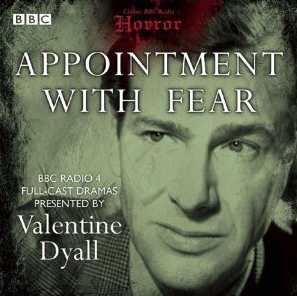
Appointment With Fear

I'm afraid you can't reschedule this...

Fans of old time horror radio all know that Suspense is considered as one of “top dogs” of horror radio dramas. What they might not know is how the show has a British counterpart. When I say “counterpart,” I’m not referring to a show with similar stories and popularity; I’m referring to an official adaptation! Debuting a little over a year after its American equivalent premiered, Appointment With Fear made a strong start with its adaptations of John Dickson Carr’s Suspense scripts (later branching out into original material) and its choice of Valentine Dyall (Best known to Americans as the Black Guardian from Doctor Who) as the show’s host “The Man in Black.” The series was a huge hit and spawned several motion pictures and even a spin-off radio series!

As was the case with their release of The Price of Fear, AudioGo has released a double CD set of four episodes from the show’s run: “The Pit and the Pendulum,” “The Speaking Clock,” “The Clock Strikes Eight” and “And The Deep Shuddered.”

Disc 1 starts off with John Dickson Carr’s adaptation of Edgar Allan Poe’s classic story “The Pit and the Pendulum.” While remaining quite faithful to the original tale, Carr expands upon and adds certain details to the story. While the original simply started us off with the prisoner suffering from his torture, the radio version has him on trial by the Spanish Inquisition for blowing up a church where the Spanish army was storing gunpowder and then moves on to the events depicted in Poe’s tale. He also cleverly added in hallucinations of the prisoner’s wife in order to prevent the script from turning into the main character simply narrating all of the events. Sound is especially well used here. The chanting of the Inquisition in the background, along with the echoes in everyone’s voices, nicely convey the dungeon setting. The sound of the swinging pendulum, coupled with the frantic tone of the hallucination of the wife add a great deal of suspense as well.

Another narrator introduces Carr’s “The Speaking Clock” (a remake of an episode of Suspense called “Mr. Markham, Antique Dealer”), although the Man in Black does narrate the opening of the tale itself. In it, we meet an antique dealer named Charles Markham, who runs a very profitable side business…blackmail. When a woman who comes into his store seeking a last minute present turns out to be a victim of his who wants to get rid of him, things get interesting. And when another party enters the picture and a murder occurs, things get even more interesting, especially when the murder victim claims that he will return within a half hour…and does. Between all the twists and turns of the plot and the hilariously nasty villain, this is one heck of ride.

Disc 2 starts of with another Carr script “The Clock Strikes Eight.” Although the Man in Black is back as the narrator, he turns over the bulk of the storytelling duties to his guest, Dr. Fell. The good doctor tells us the tale of the Barton Case, which involves the pending execution of one Helen Barton for the murder of her fiancee. The problem is that she claims to be suffering from amnesia, but nobody believes her. When her memory apparently returns a few hours before her scheduled death and she claims innocence, things get complicated. Even moreso when her fiancee’s brother is seen prowling outside the prison. As was the case with the other time-related episode, there are plenty of twists and turns here.

The final story is “And The Deep Shuddered” by Irish actor/playwright Monckton Hoffe, which opens with an asylum director points out a specific patient to a visitor. She’s a woman who survived the shipwreck that killed her husband thirty years ago and is convinced she’s still on the boat. She never tells anyone what happened and laughs in an odd manner whenever she hears a recording of a song she heard on the voyage. When things transition to her memory of the fateful voyage, we finally get to see what made her go insane. In my opinion, this is the weakest story of the bunch. Its only horror connection is the protagonist’s going insane and the listener has to endure much soap opera-style shenanigans before the “big reveal.”

That said, this is an excellent release. The liner notes provide an in-depth look at the history of the series, including pictures of vintage magazine ads for episodes of the series. Sadly, this will most likely be the only release of episodes from Appointment With Fear. This is because these are the only four episodes that survived the BBC’s infamous practice of “wiping” shows (both radio and television) in order to save money on storage (among other issues). This is also the reason why sometimes audio issues, such as static and hissing, pop up in the episodes presented on the disc. In case you were wondering, “The Pit and the Pendulum” is from 1943, “The Speaking Clock” was the 1944 third season opener while “The Clock Strikes Eight” was the closer for that season, while “And The Deep Shuddered” was from the sixth season in 1945.

Given the successes in recovering several lost episodes of Doctor Who (along with episode reconstructions using fan-recorded audio), I remain hopeful that further episodes will be recovered someday. Although I don’t know for sure if Appointment With Fear ever received airplay out of the UK, I can easily imagine transcontinental pen pals swapping “taped off the air” recordings of it or authors who had their works adapted on the show having copies of shows stashed away among their personal possessions. As the program does not seem to be included in the BBC Archive Treasure Hunt, I’m officially putting out the Bat Signal for all of our readers. If you have any episodes of Appointment With Fear that were not mentioned in this review, please contact the BBC, AudioGo or Gravedigger’s Local 16 as quickly as possible.

Special thanks to AudioGo LTD for the review copy!

08/31/11

Freaky Tiki Surf-ari: King Kong vs. Godzilla Soundtrack

Akira Ikufube

Official Site (Label)

King Kong vs. Godzilla Soundtrack, La-La Land Records 2006 (Original release date: 1962)

Yeah, like we'd be dumb enough to try using a picture of Godzilla without Toho's expressed written consent.

I know this seems like a bizarre way to close out this year’s Freaky Tiki Surf-ari. Truth be told, even I thought the idea that the King Kong vs. Godzilla soundtrack had anything to do with exotica music seemed odd at first. But as strange as it seemed, seeing the phrase “It’s Cocktail Hour at the Godzilla Tiki Bar” at the Amazon listing for the CD definitely caught my interest. Being a big Godzilla fan, I ordered the CD in order to experience it for myself.

I think part of the reason people might find the idea so surprising is due to their only being exposed to the American version of the film. What was originally a humorous commentary on commercialism in Japan was reedited into a serious science fiction movie. One of the casualties was the vast majority of the film’s score, which was replaced with stock music from a variety of Universal films. According to this, these films include Creature from the Black Lagoon, Bend of the River, Untamed Frontier, The Golden Horde, Frankenstein Meets the Wolfman, Man Made Monster and The Monster That Challenged the World. It wasn’t until La-La Land Records issued this CD in 2006 that the original soundtrack had an official release in America. Rather than discuss things like how the film originally started development as “King Kong vs. Frankenstein” or the how Godzilla really doesn’t win in the Japanese version, I’d rather discuss the composer for awhile before reviewing the album itself. Oh, and since this is a soundtrack review, please be warned that the names of the tracks may contain spoilers for the events depicted in the film.

Back when the classic Godzilla films were first hitting American screens, Akira Ifukube was one of the few (if not the only one) people involved in the making of Godzilla movies whose name could be found in American reference books. Ifukube’s love of music began in his youth and he even practiced composing in his spare time after his university studies. He obtained his first taste of international recognition in 1935 for his winning of the Tcherepnin Prize with his composition “Japanese Rhapsody.” His first film score came in 1947, when he composed the score for the movie The End of the Silver Mountains. Many more film scores would follow, including numerous daikaiju films for Toho. In fact, Ifukube was responsible for creating Godzilla’s famous roar and footstep sound effects! Although he is sadly no longer with us (he passed away in 2006 from multiple organ dysfunction syndrome), his music and legacy live on.

Powerful music and native chanting make up the “Main Title” while “Series of World Wonders” is an extremely brief vibraphone-style opening theme. Those who have seen the American version of the film might remember a shot of a less than realistic model of the planet Earth floating in space. In the original Japanese version, this was part of a gag involving the opening of the above-mentioned fictional television series. However, the footage revealing the joke was removed from the US cut of the film and led to many reviewers citing the scene as an example of “cheesy special effects.” In the first of many combo tracks, “The Sparkling Iceberg/Pashin Commercial” starts off very soft (with a touch of creepiness) and builds up, while cymbals and percussion lead to the commercial tune. The Lymanesque “Fujita & Fumiko” is a fantastic jazzy piano tune with soft saxophone work and what seems to be a touch of vibe work. “The Seahawk in Crisis/Great News Gathering Team Departure” starts with a buildup of suspenseful music with touches of the classic Godzilla theme while bass drums give a sense of power. This contrasts with the next song’s cheerful tuba march music. “The Seahawk’s S.O.S.” is appropriately dark and mournful, with eerie touches that would fit in well inside The Twilight Zone. In the quick “Faro Island,” drums and soft wind instruments convey a tropical feel. In the similarly quick “The Natives” features a soft, slow build up on the gong and chorus of native voices. “Southern Island Tale” is a jaunty, jazzy tune with pianos and playful female Japanese vocals.

“Thunder and the Devil/Fumiko’s Misgivings” opens with pounding and chanting that is similar to (but distinctly different from) the opening track. However, things slow down and soft drums take over for the Fumiko part. “Godzilla’s Resurrection” is pure power and terror in audio form. In other words, it’s the Godzilla theme that all G-fans know and love. “The Cry of the Devil/A Prayer to the Rolling Thunder” opens with soft (but stern) drums and the occasional use of horns. Both parts blend very well into each other. In “The Devil of the South Seas/Drums of Battle/Giant Octopus vs. King Kong,” things pick up in terms of both volume and feel, as terror and unease enter the picture. Native drums quickly build up and vanish as we enter next portion. It may surprise some to learn that the octopus was realized through a combination of puppetry, stop motion animation and use of live octopuses on miniature sets. In fact, one of them wound up as special effects director Eiji Tsuburaya’s dinner! In “The Sleeping Devil,” soft drums and familiar chanting are used to lull the giant ape to sleep. In “The Terror of Godzilla,” the classic Godzilla theme returns and in “The Invincible King Kong/Preparation for Operation ‘Burial,’” more unease and a sense of regality are heard. “King Kong vs. Godzilla I” has a soft opening buildup which quickly builds in both power and intensity. There are also echoes of the native chanting in terms of overall feel and not actual usage of said chanting. It’s hard to explain, but you’ll know what I mean when you hear it. “Preparations for Operation ‘One Million Volts’” is serious and militaristic while “Operation ‘Burial’” is suspenseful and owes much to the Godzilla theme, as does “Operation “Burial” Fails” and “Operation “One Million Volts” I.” In sharp contrast, “Operation “One Million Volts” II” features soft drums and more of the unease/King Kong feel. “Kong Shows Up in Tokyo” builds upon the themes set by last track and also incorporates vibe-like touches. While “The Plan to Rescue Fumiko I” features drums and soft native chanting, “The Plan to Rescue Fumiko II” use of chanting and drums is more energetic and even a touch militaristic. The busy “The Plan to Transport King Kong” coveys a military-style sense of purpose and action thanks to its use of drums and horns. The creepy opening drums of “King Kong Advances on Fuji” creates the sense of a gigantic monster approaching. “The Confrontation at Fuji” offers a fusion of styles: native chanting playing under a military march/Godzilla theme variation. Similarly, “King Kong’s Resurrection” combines Toho’s King Kong theme and native drums. “King Kong vs. Godzilla II” is frantic and fast-paced battle theme while “Ending” has a soft opening that builds up to big farewell. In the first of two bonus tracks, “Main Title (mono)” provides exactly what the name implies. “Main Title (a cappella)” is a drum-free version of opening. I should stress that this is an all new version of the opening theme and is not just the opening with instruments stripped out. It’s fascinating to hear only native chanting without any backing instruments, along with the new touches which seem to have been thrown in.

Although not of the all is exotica-related, there is enough of it to interest fans of the genre. If you’re looking for a present for the Tiki fan who has everything, this is the perfect choice. Japanese monster movie fans will appreciate the detailed liner notes by David Hirsch, which cover both the making of the film and provides details about each track on the album. Even if you are not an exotica fan, this is an amazing album that demonstrates how Akira Ikufube is a true master of his craft. Just be sure not to dawdle, because it’s now out of print and the price is rising fast!

08/31/11

Dead on the Beat

Since I’m no longer under the legal drinking age limit, I don’t watch MTV anymore. Because of such, I had no idea that the network developed its own take on the “cops v. spooky” fad that’s hitting us soon. I knew about that ‘Teen Wolf’ remake but this ‘Death Valley’ show was under my radar.  io9.com has a clip of a funny moment of this mockumentary-style show.

Meredith Woerner (which, I might add, is a great last name. She might be a supervillian or a mad scientist with that name. Dr. Meredith Woerner’s creature. Has a nice ring to it? Anway.) wrote “…[w]hile we might tune in to see the scene from the trailers where one of the cops punches a zombie through the skull (because that’s excellent) we may just watch reruns of Reno 911 instead.”

But, from the clip in her write-up, it seems that his is more serious than Reno 911. MTV is trying to blend sex, action and comedy in a moderately-budgeted production.  It’s currently a “wait and see” situation but what I see ‘Death Valley’ facing some stiff (no pun intended) competition from the other cops v. corpses media coming. On top of the RiPD movie, there’s Zombie Hunters and ZEROs coming out. ’Death Valley’ has the advantage of being on MTV (and having Viacom’s promotional juggernaut) but depends on what the audience wants (and what MTV wants.) 

I think they want to make a quick buck before the spooky bubble bursts. I, and plenty others, have waited for the bottom to fall out of the supernatural market. Still. More undead cop shows. It’s like it’s taking the two more overused genres and mashing them together.  Law and Order: SZU (Special Zombies Unit)

Good luck to everyone involved. It’ll make good Hulu/Netflix viewing in a few years.